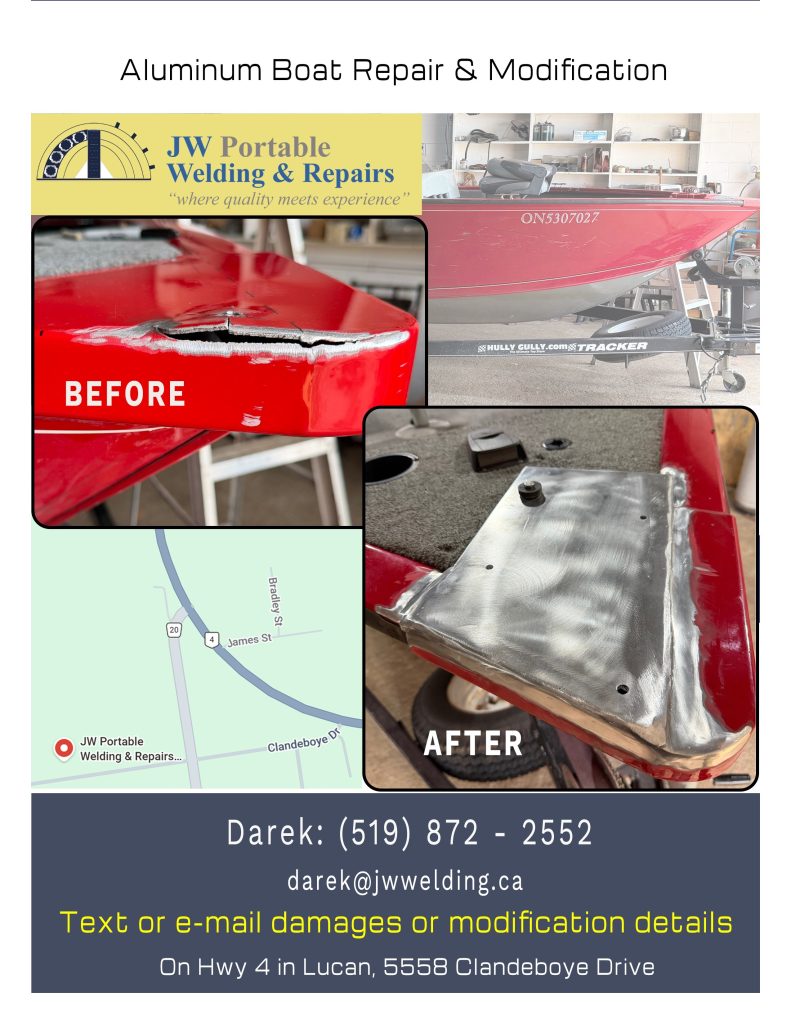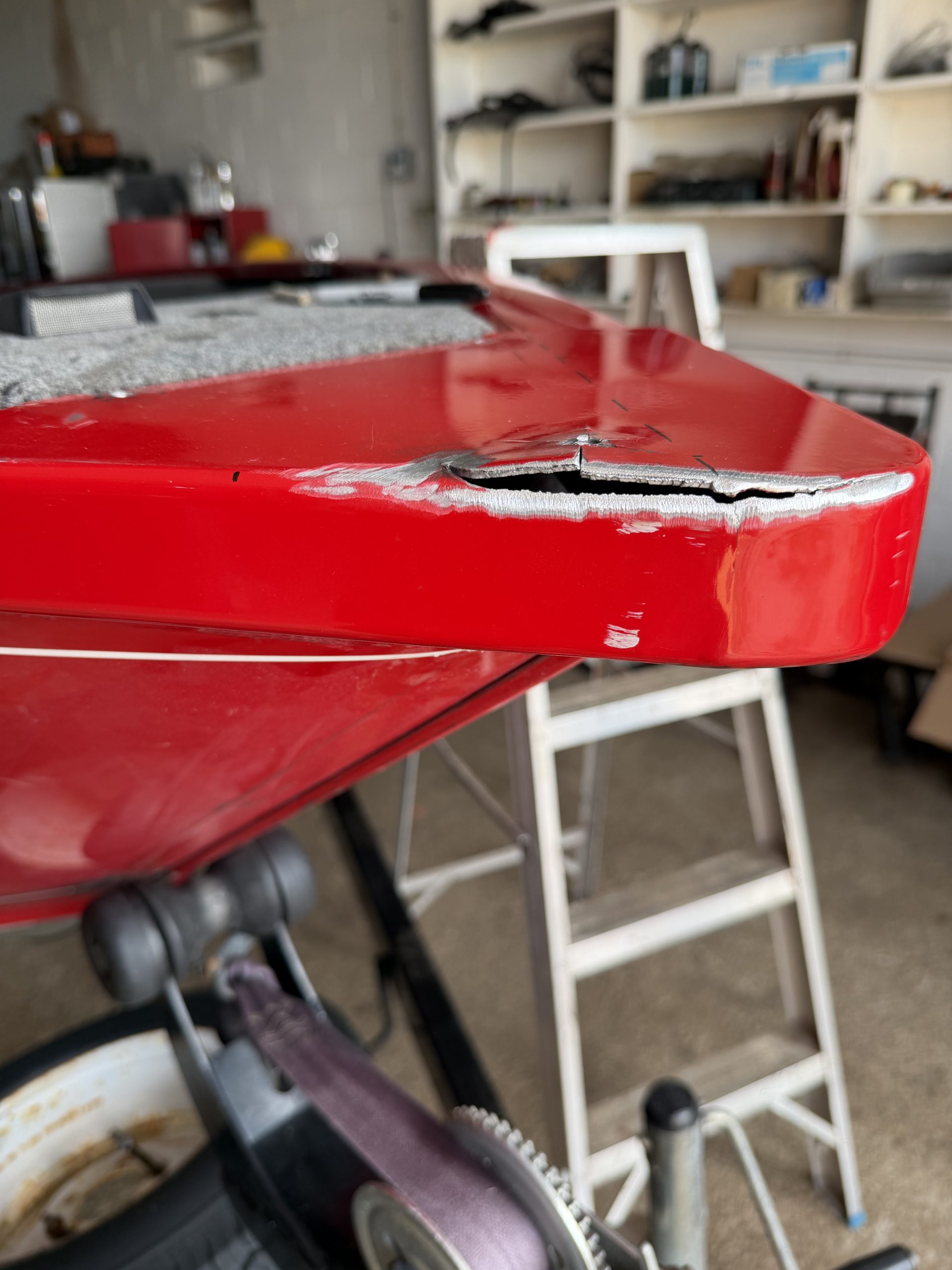
JW Portable Welding & Repairs offers aluminum boat repair by welding in our shop in Lucan. In our shop we can accommodate trailers with boats up to 35 feet long and 16 feet high. Large parking spots can also accommodate larger trailer with boats designated for repairs on our front yard and side yard. We repair damages such as cracks, holes and dents in different locations on aluminum boat. In fact, we can repair these damages in hull, bow, transom, stern and gunwale. Many of our repairs involve modifications to strengthen the damaged spot in order to prohibit future damages in this particular location in the future. After repair by aluminum welding the spots usually grinded and then buffed smooth ad are ready for painting. We also pressure test pontoon boats for maintenance purposes to eliminate their leaks.
Estimated reading time: 15 minutes
You can contact us and send multiple images of aluminum boat damages or drawings of your desired modifications. You can also text us images and videos on the phone number provided there. After we do an excellent job, please leave the 5 stars review of our service. You are leaving the rating for the welding shop in Lucan and for the employees working there.
If you are concerned about your modifications please visit our fabrication page and inspect complexities there. Please inspect more technical analysis of cracks in aluminum We also fabricate in stainless steel and mild steel. Additionally we specialize in welding cracks in heavy equipment.
Aluminum boats crack often under impact or due to vibration fatigue. The force of impact and the vibration characteristics have significant impact on the size of these damages. In simple terms, the aluminum has tendency to crack instead of bending. The thinner aluminum has low resistance to damages resists damages. Unfortunately, majority of boat’s body structure contains thin aluminum and thin aluminum that cracks very easily. Therefore, aluminum boats are lighter that provides increased buoyancy but they crack relatively easily.
The aluminum boat repair by welding begins with proper planning, and then follows with removal of paint and more planning. The thin aluminum structure refiles truly its damage after removal of paint. Then often we must make a decision if we will proceed to aluminum boat repair by welding or we will fabricate the element that will improve the strength of the damaged spot and then we will weld the fabricated element to the aluminum boat. At the end we usually grind the welds smooth and then we buff them to receive the smooth surface suitable for painting later. We also can leave the characteristic stack diamond welds pending the customer request.
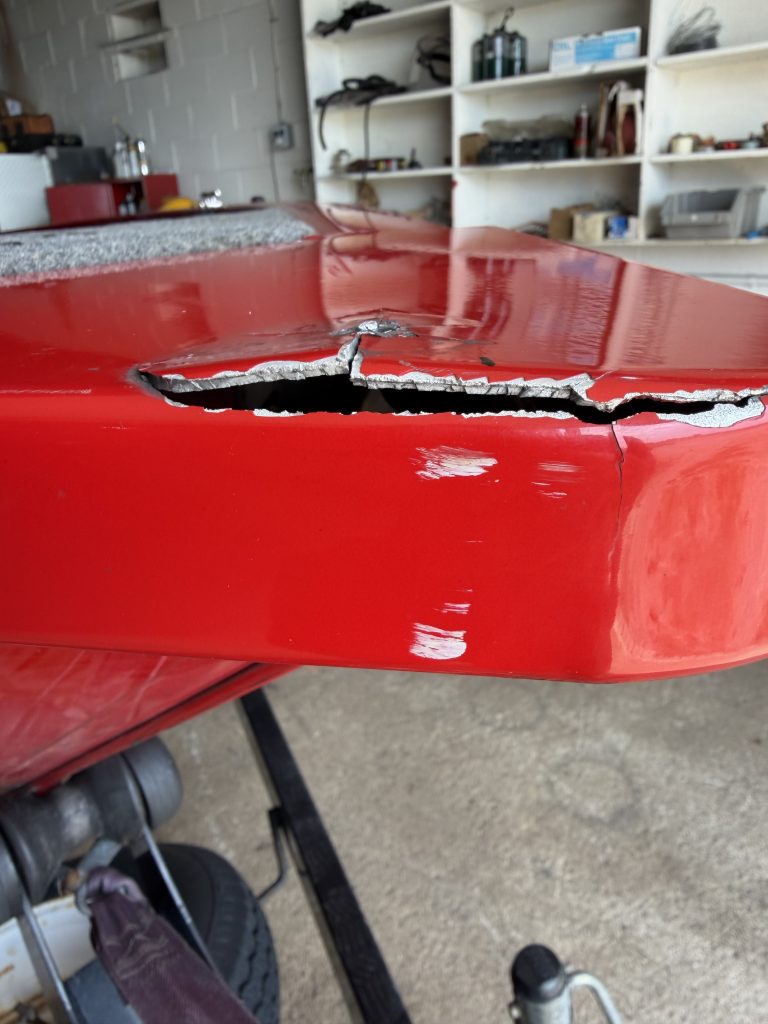
Welding aluminum is difficult and requires proper material preparation, skills and relatively advanced welding technology. We know it well since we have started with aluminum fabrications for construction industry many years ago.Therefore the main 2 objectives of planning should be avoiding potential welding problems and increased strength of damaged spot. The main factors to consider is thickness of aluminum material in the damaged area and the shape of damaged area. If the damages are severe as in example above the material replacement or structural modification is more appropriate.
In our example the material of aluminum bow is 1/16 that manufacturer has chosen for easier shaping of the bow element. We however, look at the damaged from the different perspective. Although, we can weld 1/16 aluminum of the main 6 inch crack without any issues, the material surrounding the mounting holes for the trolling motor would still stay relatively deficient. Especially venerable will be areas close to edges of the mounting holes.
In addition we have found out that the top surface of the bow is nor flat nor horizontal therefore some holes will still experience excessive forces in comparison to other holes. Additionally, one hole located in the wooden structure covered by the fuzzy fabric lays down about 5/8″ below the plane formed by other 3 mounting holes. That is why we have opted for modification that will increase the mounting strength and will put all 4 mounting holes in one plane reducing the vibration fatigue. The only challenge left would be to weld the 3/16 aluminum plate to 1/16 aluminum bow material. Therefore, we had to plan very carefully the places for our welds to provide the maximum support of bow material to our welds.
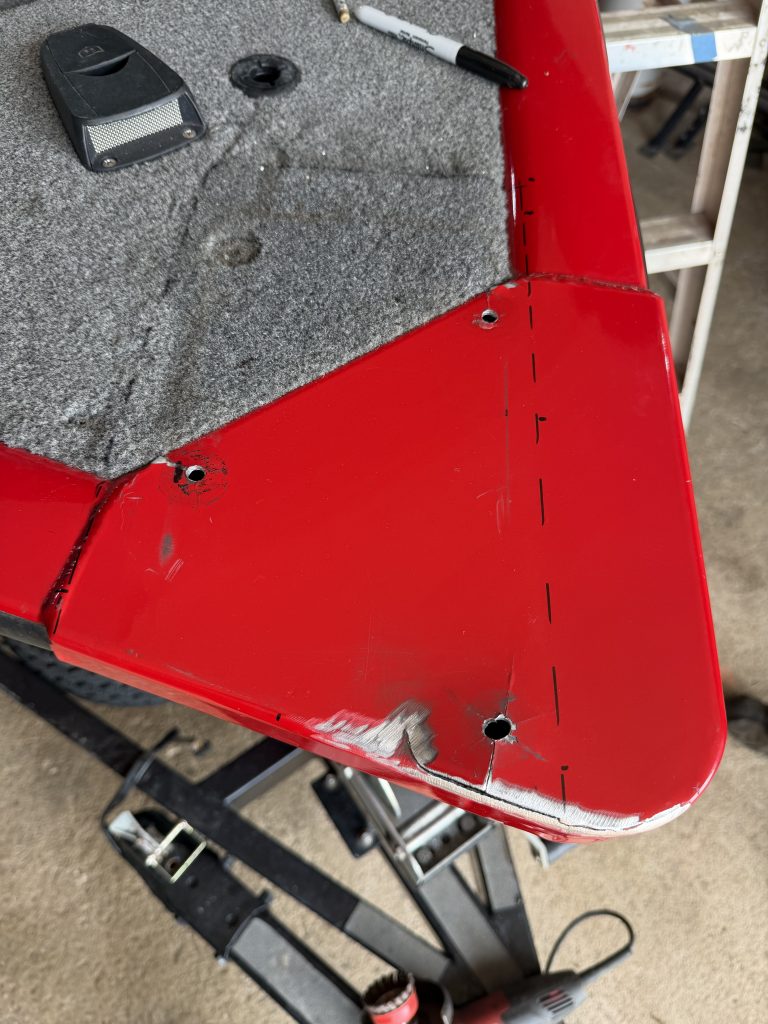
We have opted for a modification template in order to precisely position our future welds in the strongest spots of the thin bow material. We also wanted to provide the client with exactly same position of the trolling motor as it manufacturer has intended. Precision in this case was very crucial for the final result.
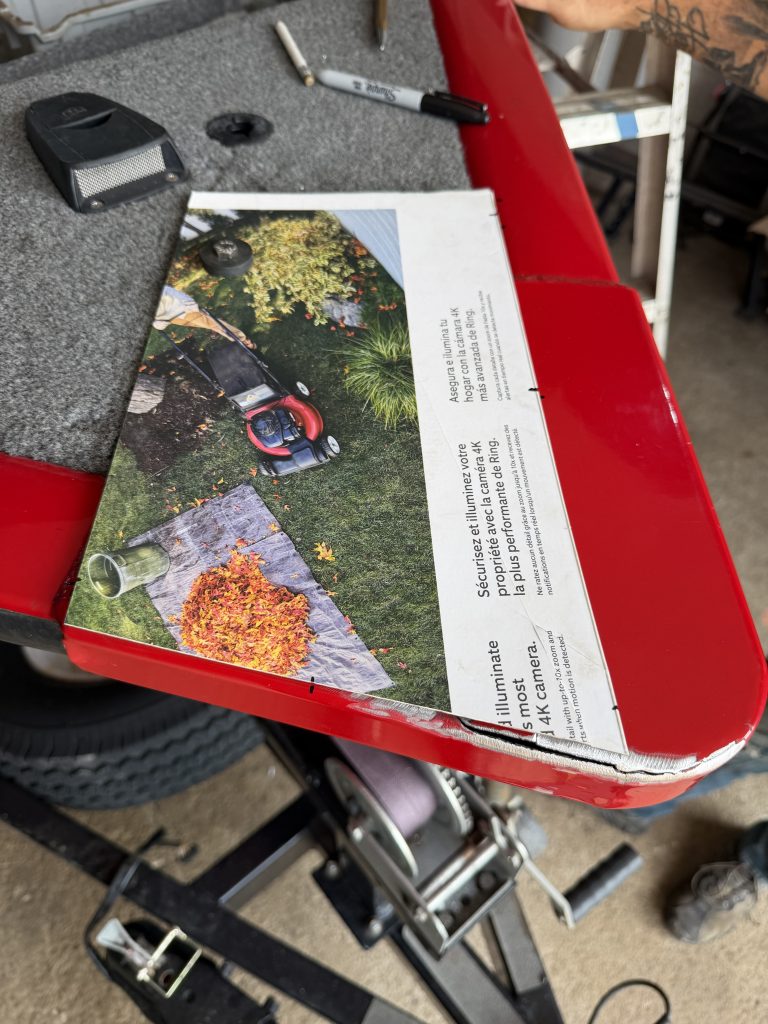
Please notice the gunwale of the bow in front of the image. We are planning to cover the 6 inch crack just partially due to the right edge of the template to go on top of inside support of formed by hull. The front of template will receive the support of our weld repair of the crack that will increase the thickness of the aluminum repair weld. This aluminum repair weld should increase the thickness of the bow material in this spot to at least 1/8 or perhaps even up to 5/32. The left hand side of the template will receive the support of weld laying under the edge.
Removal of paint prior and welding of aluminum boat is necessary. The gentle removal of paint is necessary since aluminum welding requires absolute cleanness of aluminum material. In mild steel removal of material is relatively well know in the industry and we have plenty of tooling and abrasives to achieve the objective. However, removal of paint from 1/16″ thick aluminum that has been damaged by cracks and deflected is not an easy task. The surface is not flat and aggressive abrasives would damage it very easily. Also, the goal is just to remove the paint without removal of aluminum. We simply cannot remove more aluminum from already thin base material of the bow.
The patience, magic touch and experience play the major role at this task. Also let’s not forget about special abrasives for aluminum that contribute to the positive results in the process of paint removal during aluminum boat repair.
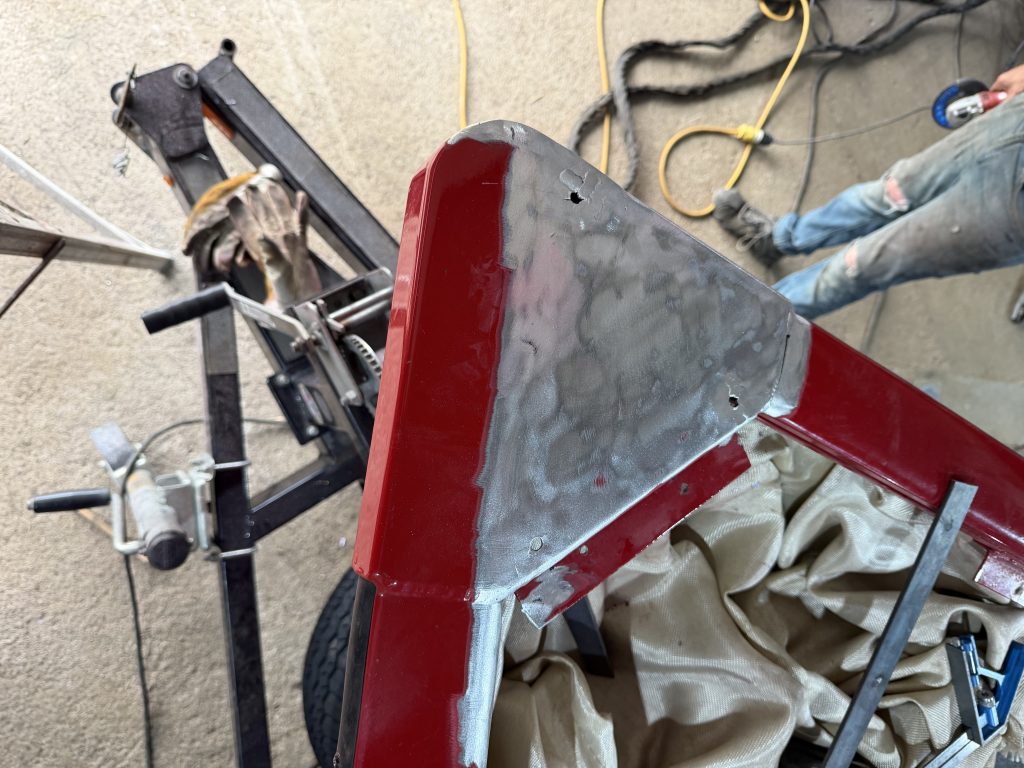
Please notice the areas of the removed paint of gunwales on both sides. On the right hand we will have the relatively easy approach due to the presence of strong weld there. On the left hand however we will require a shim to eliminate the gap between the fabricated plate and the top surface of gunwale. Please also notice that we didn’t completely removed the caps from repairing welds of cracks close to the mounting holes.
The alignment of the fabricated plate on the bow of this aluminum boat has taken 3 locating pins, 2 c-clamps, 1 Bassey camp, and 2 flat bars. The locating pins have allowed to position of holes very accurately. The 3 clamps has allowed us to flatten the original bow material, and eliminate the gap between the fabricated plate and bow. The 2 flat bars have allowed us to spread the tension of clamps through the whole surface of the plate.
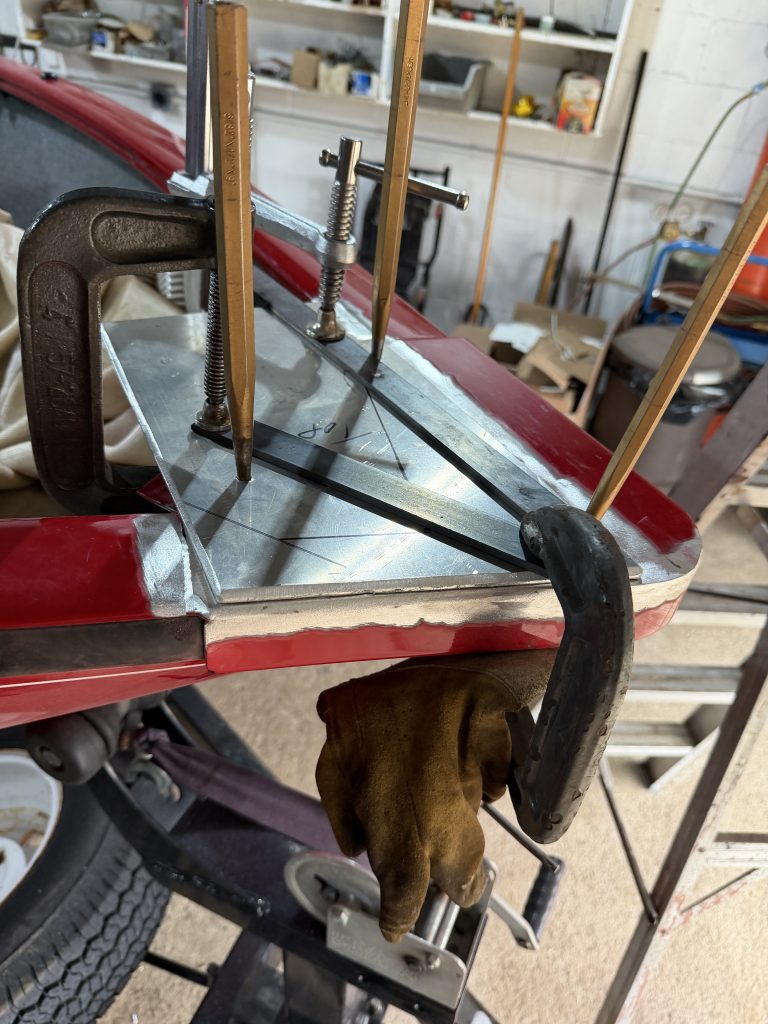
Perhaps this example is rather extreme but it visualizes how difficult is to precisely stabilize pieces of aluminum prior aluminum boat repair by welding. The surfaces of the boat are not suitable for clamping since they are not parallel to each other and we can’t use magnets to stabilize anything on aluminum. Having modified clamps definitely helps in positioning process of aluminum material.
Please notice also how we have welded this 6″ crack of the bow and what contour shape we have chosen for the cap of this weld.
The new fabricated 3/16 mounting plate replaces the original 1/16 compromised mounting plate. It allows to mount the trolling motor on one plane surface. The position of 4 mounting holes has not changed by this modification. The hole with the rubber washer has washer between the wooden structure and the aluminum plate for stronger perpendicular support.
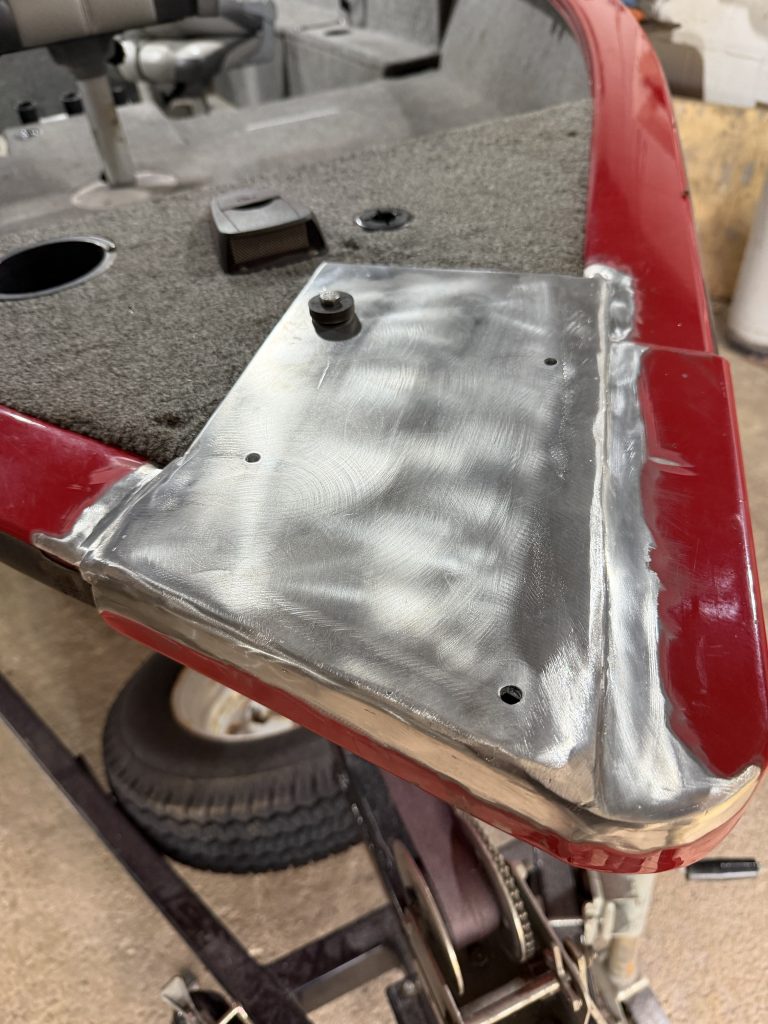
All welded surfaces are ready for painting.
Holes in aluminum boats appear mostly due to friction abuse or punctures. Punctures do happen but not too often. However, friction abuse is very common especially in fishing aluminum boats. Dragging the boat on the gravel shore will cause multiple holes at the boat keel since it is the lowest part of the boat. These friction holes generally lay close to each other and they weaken the whole area. Therefore, the welder must plan the welds carefully to keep the temperature within the controlled range. Therefore, we often control the temperature prior every pass with heat sticks.
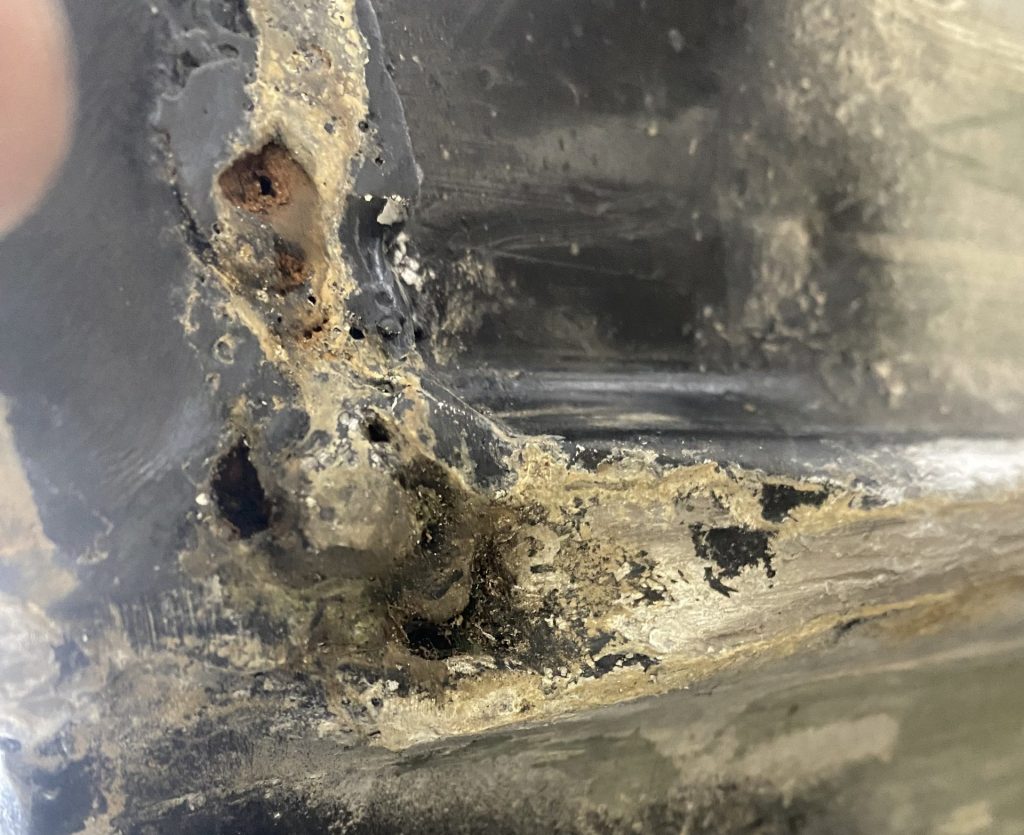
Cleaning the holes is always challenging since we need to remove the sand, dirt and small stones but we do not want to create more holes or larger holes, Again patience and magic touch makes the whole difference. Having modified tools also makes such task a bit easier.
We also employ mini grinders to clean the holes in order to go deeper to the hole without damaging the surface of the hole. Regular pencil grinders are too aggressive for cleaning holes in aluminum boat repair process.
Welding of holes in aluminum boats is tricky due to overhead position therefore the welder should take time to find a comfortable position. Plugging the hole movement of the gun is similar to plugging the hole in mild steel.
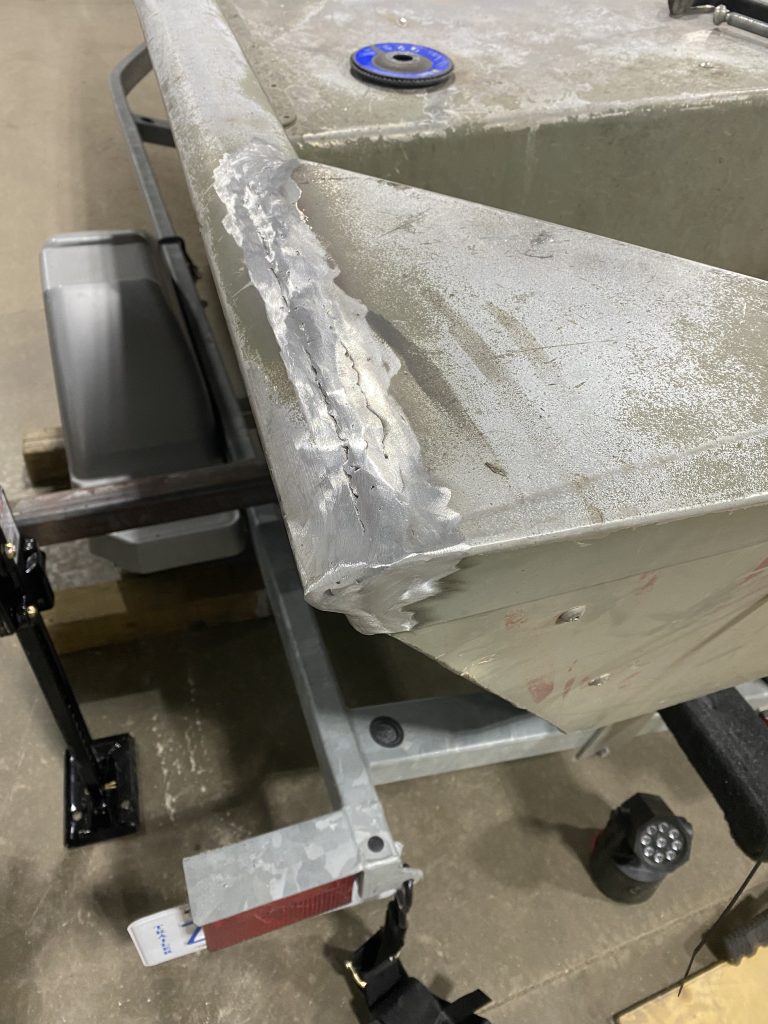
Gunwales provide rigidity to the whole boat structure and they are exposed to damages from impact with docks. The fishing boats especially exposed to damages of gunwales since owners try to keep their boats as close to the dock as possible to make unloading the fish easier.
Welding gunwales in aluminum boats must be done with proper understanding of gunwales role. In simple term, gunwales are bumpers and we should treat gunwales’ damages as bumper damages. The cracks of damaged gunwale appear on the deck side and therefore they are easy to spot. However, the crack often reach the joint with the hull and/or traverse as in example above. The detail inspection often reveals hidden cracks under gunwale on the hull side.
Weld repairs of gunwale should involve rather large and thick welds that will increase the strength of the gunwale. We also prefer to increase the length of gunwale repair due to hidden cracks under this structural element.
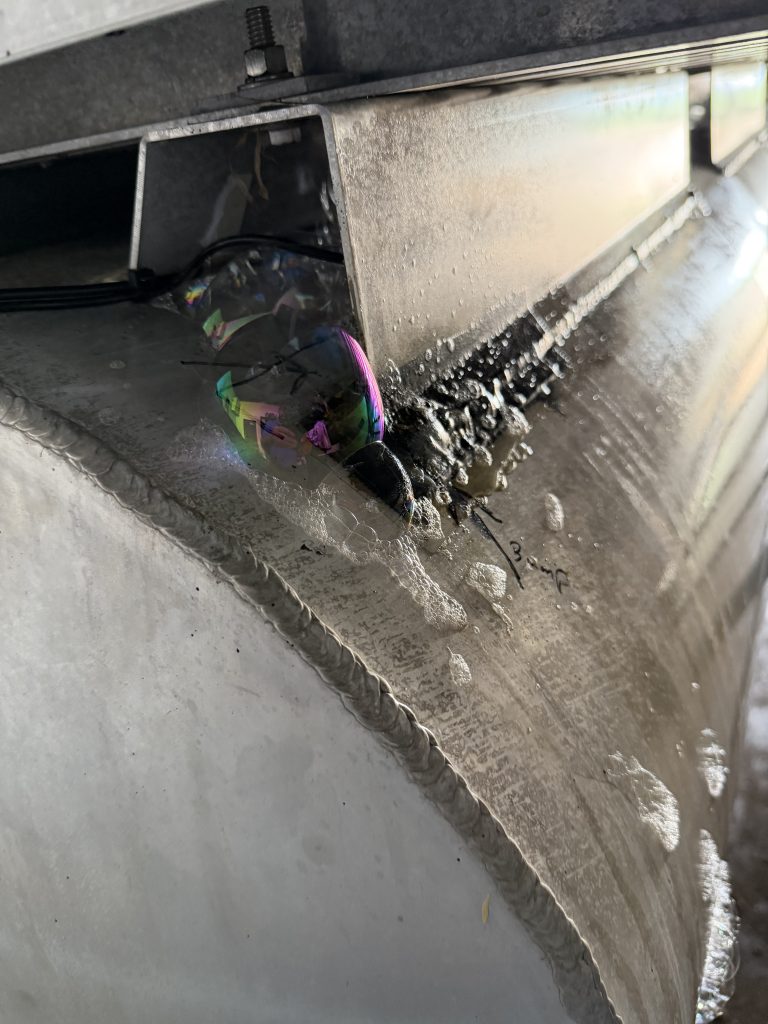
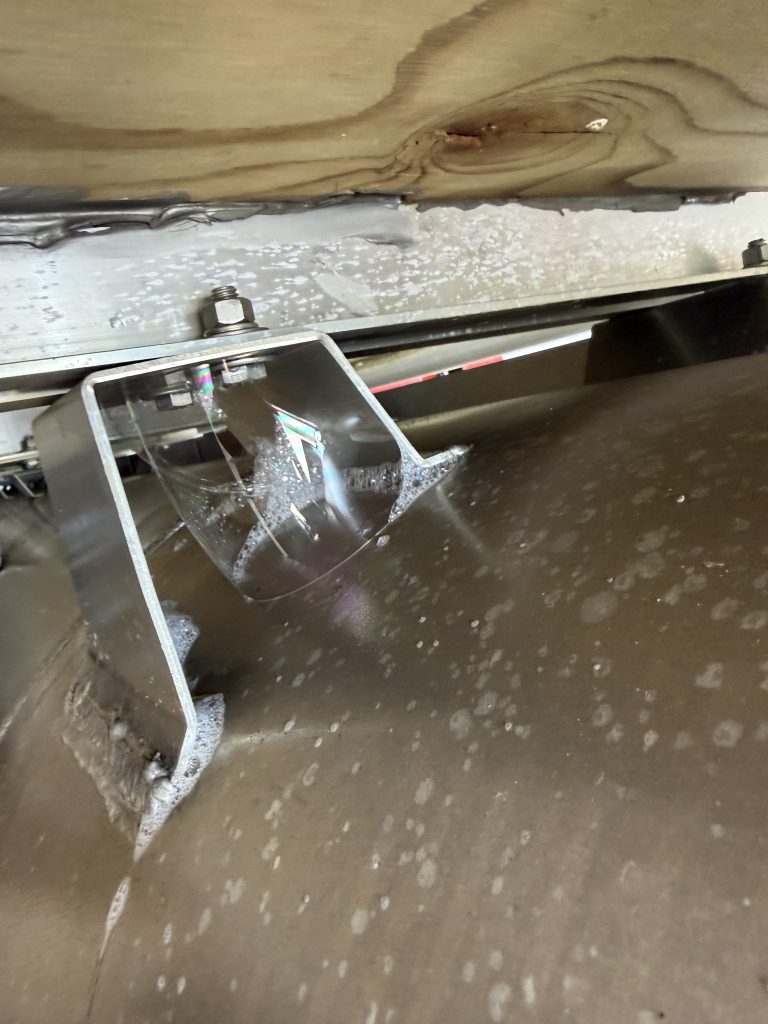
We offer pontoon pressure tests within our maintenance program and we recommend pontoon pressure test every 2 years to our clients. The pontoon pressure test results and their interpretation depends on the hole size, hole location, number of holes, inflow of water, frequency of sailing and storage patterns.
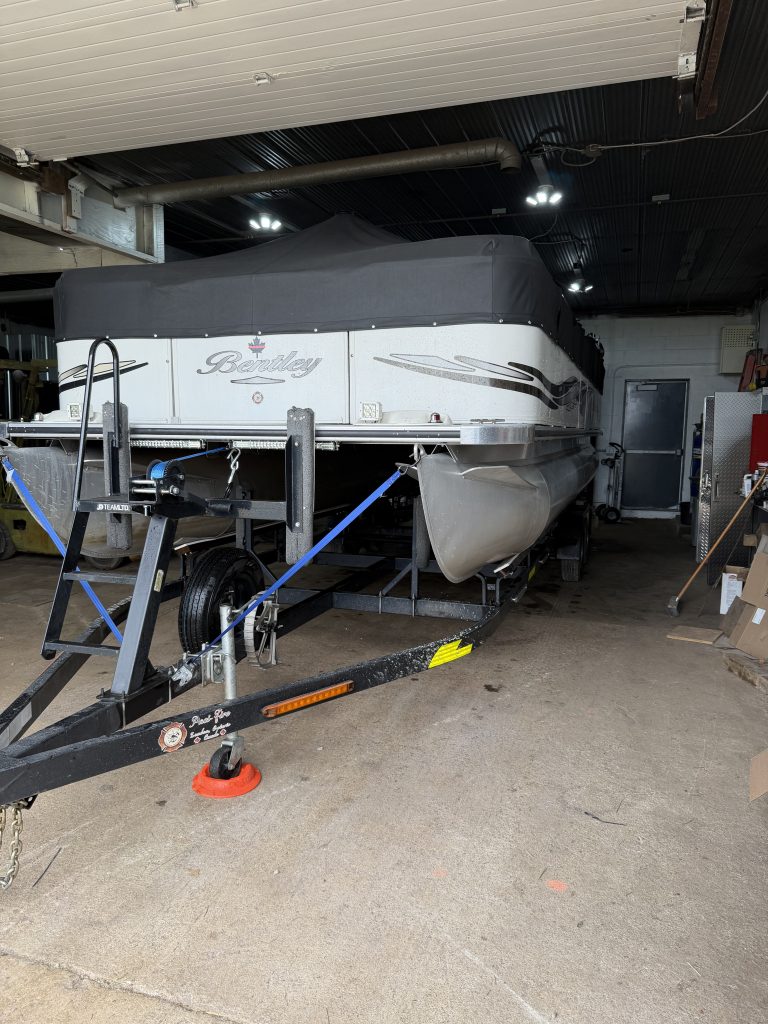
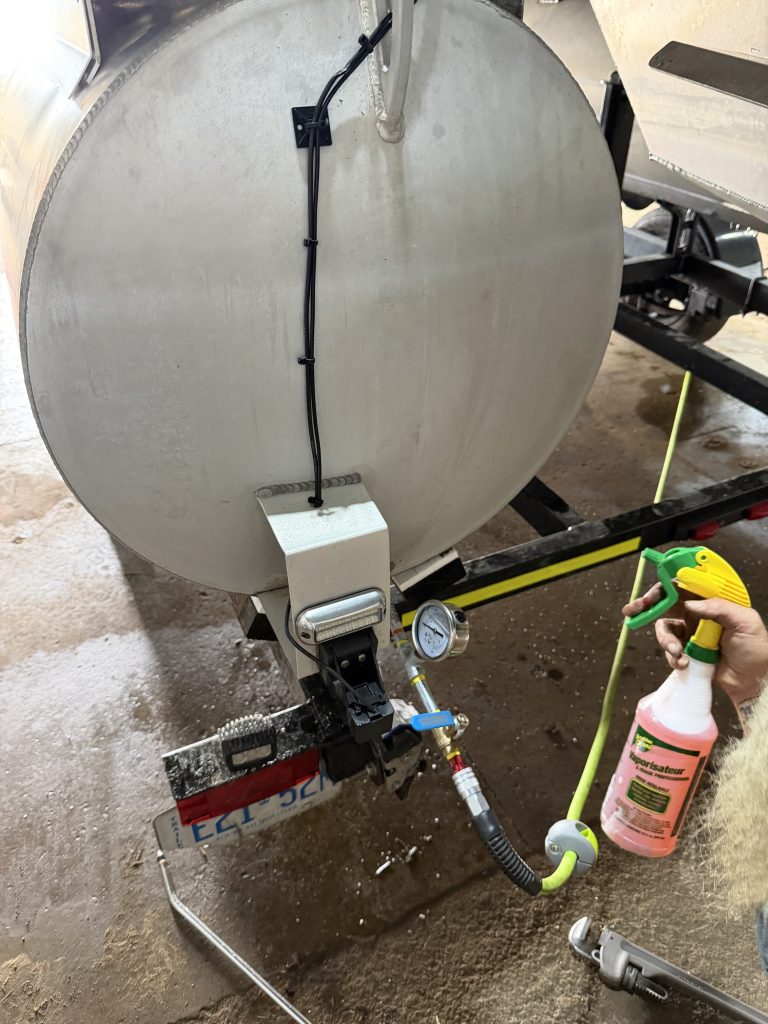
Due to the cost of hole repairs in the pontoon boat certain common sense evaluation is necessary.
The epoxy glue will not seal any holes on the pontoon even if they are small. The proper use of epoxy glue for holes involves forming a plug, anchoring the plug and then applying stabilizing patch. Generally speaking material thickness of pontoon does not allow for anchoring the plug.
Removal of your epoxy glue is difficult for us when we want to fix the whole properly. Therefore, it will cost you more if you come to us with holes that have been covered by epoxy glue.
Please locate our flyer in your marina for professional aluminum boat repair by welding